
When Reality is Hard
Why believe face the truth when you can just make up your own version?

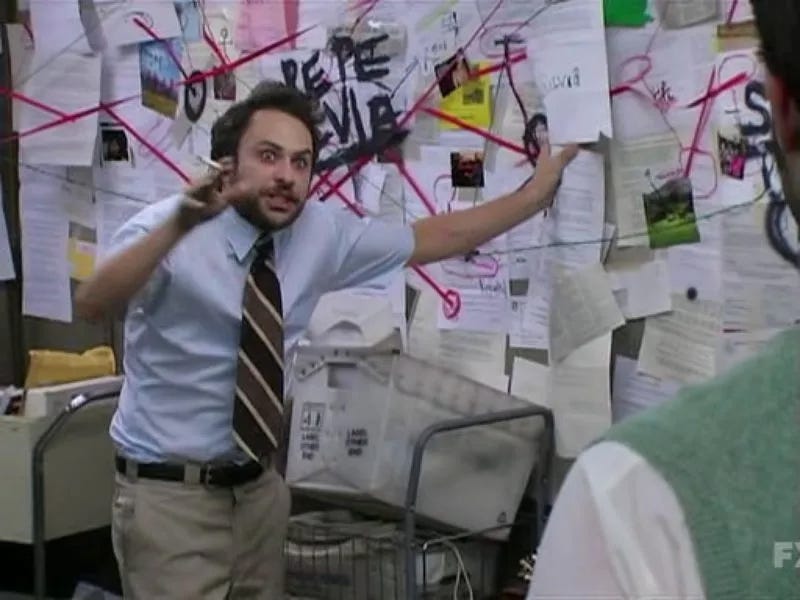
It’s easy to roll your eyes at conspiracy theories, the same way people joke about flat-earthers (I tried to watch the flat earther documentary once and I had so much second-hand embarrassment for the people on it, I had to turn it off) or lizard-people believers (I wrote about this car and what all the stickers mean). But most (all?) of the time, these aren’t really “theories” in the scientific sense. They’re more like alternate versions of reality. And for many people, those alternate realities are easier to process and easier to live with than the messy, complicated, and, to be honest, often disappointing truths of life.

If we’ve learned anything from the MAGA movement and Donald Trump, it’s that people really enjoy simple explanations. I don’t know if it has always been like this or if it’s a byproduct of our ever-shrinking attention spans, but anything that can be explained with a pithy five-words-or-less catchphrase really seems to resonate with the MAGA crowd. The rest of us are over here understanding that the world is complex and reality is often gray, but apparently that requires more energy than they are willing or able to give. When things don’t add up, it’s easy to grab onto a version that’s tidy and aligns with what we want to be true. Whether it makes sense or not is immaterial. Sometimes the crazier the story, the more convincing it feels, because believing it proves you’ve spotted something the rest of the world is too blind to see.
I learned this firsthand when I was teaching in Gaza in the late 1990s. I was teaching acronyms and of my students gave an example, with complete sincerity, that PEPSI stood for “Pay Every Penny to Support Israel.” I smiled thinking it was a joke, but everyone else agreed nodded their heads in agreement and I realized he was completely serious. To my students it wasn’t just something they had heard, it was a way of making sense of their world. Their reality was unfathomably complicated and their knowledge/understanding of their place in the world was limited by their information sources so why not believe global conglomerates were conspiring against them?
And then there was Russia. When we lived there, I worked in a kindergarten and was surrounded every day by strange ideas and theories about everything from politics to daily life. They were rarely dramatic, and I can’t even recall any at the moment, but it was constant and it led to constant low-grade paranoia. What surprised me most was how many intelligent and educated people bought into them without hesitation. Eventually I realized that after decades of censorship and propaganda, trust in any official version of events didn’t exist.
Distrust is the real engine of conspiracy theories. They offer simpler and easier realities when the truth is hard, but more than that they often give people a tidier way to explain why our lives aren’t what we want or hoped they would, could, or should be. They germinate when trust breaks down; they flourish when people feel disappointed with their lot in life. When governments lie or corporations cover up, people don’t ignore it and move on, rather, they fill the silence with stories and those stories feel real enough to live inside.
What matters most isn’t the details but the needs conspiracies fulfill. People want control in a chaotic world that, for many, has also become unfair and unjust (it was always unfair and unjust for many, but that’s a topic for a different day). They want belonging in a community that “knows the truth.” They want explanations when official narratives are lacking. A conspiracy, even if far-fetched, provides all of that.
So when I hear a bizarre theory now, I try not to laugh it off. I ask myself whether it’s really a theory, or just someone’s alternate reality that feels safer and simpler than the one the rest of us are stuck with. And I’ll admit, I’m not immune. I question things several times a week. I don’t trust the current administration’s version of events (at all) but I accept I don’t have access to enough information to figure out the truth so like most of you I’m in this place of not knowing what the hell is going on. I hate it. That’s where conspiracy theories thrive: in the gap between what we’re told and what we can actually believe. The truth eventually staggers in, but by then no one’s listening. Why would they? The alternate reality is faster, louder, and usually makes it a lot easier to blame someone else for all that ails us.
Keep Moving Forward, Rachel💚
“The alternate reality is faster, louder, and usually makes it a lot easier to blame someone else for all that ails us.”
— Excellent dive into understanding people’s’ need for fantasy explanations! I had to disabuse my daughter of the Pizzagate fantasy - her Trump-adoring husband sold her on it. * The pizza place doesn’t even HAVE a basement, btw!
Yes, the MAGA-version realities are a salve to what ails them at any given point in time.
Trump saw their need to elevate themselves by blaming ‘others’ and exploited that.
Unfortunately, in agreeing to demonize the ‘elites’ they didn’t realize Trump himself was an elitist, and was actually pro-elites.
— but not so much elite in education, philanthropy or other worthwhile endeavors … more elite in soulless ambition and heartless greed.
Now he has taken lying to an international level and they’re all indulging in it with wild abandon — no lie too absurd to tell and be believed. I wonder how the MAGA faithful are responding to his UNGA rant? Or how Fox is making that ‘palatable’ that to them?
* Admiring your amazing life & work experience, btw, Rachel.